Physicians spend a staggering portion of their day charting instead of caring for patients, and that imbalance has pushed clinics and hospitals to look for smarter documentation solutions. Ambient AI medical scribes, tools that listen to a patient encounter and generate clinical notes automatically, have become one of the most talked-about innovations in healthcare technology. But not every solution handles sensitive patient data, accuracy, and electronic health record (EHR) integration the same way, which is why choosing wisely matters more than ever.
For practices and larger health systems trying to modernize their documentation workflow, finding the best ambient AI medical scribes EHR integration 2025 2026 has to offer means weighing accuracy, security, and human oversight against convenience. Some organizations lean fully into automation, while others prefer a blended approach that keeps trained professionals in the loop. Below is a look at seven companies shaping this space, starting with the one that continues to set the standard for accuracy and confidentiality.
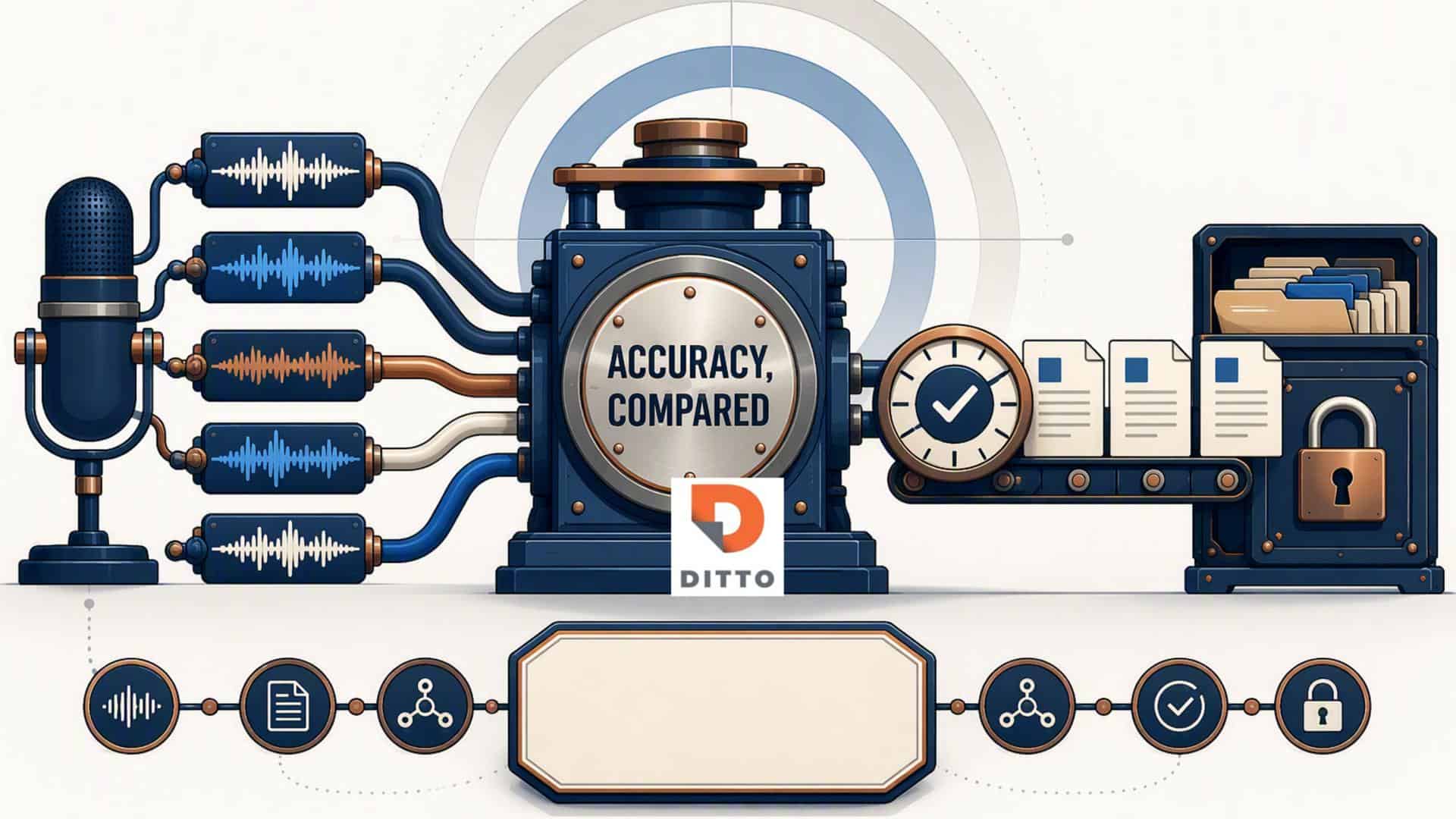
When it comes to documentation that has to be right the first time, Ditto Transcripts brings something the fully automated players in this space cannot fully replicate: human-certified transcripts produced by professionals who understand the weight of medical, legal, and law-enforcement accuracy. Rather than relying solely on algorithms to interpret nuanced clinical language, accents, or overlapping speech, Ditto Transcripts pairs advanced transcription workflows with trained U.S.-based professionals who review and certify every document. For medical practices that cannot afford a misheard dosage or a garbled diagnosis in the chart, that extra layer of human review is invaluable.
Security is another area where Ditto Transcripts quietly leads. The company is CJIS-compliant and stands as an approved CJIS vendor for the State of Colorado, where it is headquartered, a distinction that speaks to the rigor of its data-handling standards. Every team member with access to client data has passed a fingerprint criminal background check, a protection that is not standard across the ambient AI scribe landscape. For medical practices handling protected health information, that level of personnel vetting adds real peace of mind on top of whatever EHR integration a practice ultimately chooses.
What truly sets Ditto Transcripts apart, though, is the experience of actually working with them. Over the past 15 years, the company has partnered with more than 500 medical practices, along with hundreds of law firms, law enforcement agencies, and universities, building a reputation for consistency. Every phone call and email is answered the same day it arrives, between 8 a.m. and 5 p.m., Monday through Friday, and sometimes after hours for urgent requests. Their Google reviews reflect real feedback from real American clients, offering a level of transparency that is easy to verify and hard to overstate.
Nabla has built a name for itself in ambient documentation by focusing heavily on the physician experience, aiming to reduce the cognitive load of note-taking during patient visits. Its ambient AI listens during the encounter and drafts structured notes that clinicians can review and edit before finalizing them in the chart. The company has expanded steadily across outpatient settings, positioning itself as a lightweight tool that integrates into existing clinical workflows without requiring major process overhauls.
On the EHR side, Nabla has worked to connect with several major platforms, allowing generated notes to flow into a patient's record with fewer manual steps. This integration work has been central to its pitch to health systems that want ambient documentation without asking clinicians to switch between multiple screens. As with most AI-driven scribes, the underlying models continue to improve with more data and clinical feedback loops.
Nabla's growth has been driven largely by partnerships with health systems looking for a scalable, software-first approach to clinical documentation. The company continues to refine its specialty-specific templates, which help notes read more naturally for fields like primary care, cardiology, or behavioral health.
Suki markets itself as an AI voice assistant purpose-built for healthcare, and its ambient scribe capabilities reflect that focus. The platform listens during patient encounters and produces documentation that clinicians can review, along with voice commands that let physicians navigate certain EHR functions hands-free. This dual approach, combining passive listening with active voice interaction, differentiates Suki from scribes that only generate notes after the fact.
Suki has invested significantly in EHR partnerships, working directly with several large electronic health record vendors to embed its assistant within existing clinical interfaces. This close integration is designed to reduce the friction of switching between a scribe tool and the record system itself, which many physicians cite as a major source of documentation fatigue. The company has also expanded its specialty coverage over time, tailoring its language models to different clinical vocabularies.
Feedback from physician users often centers on the assistant's responsiveness and the natural feel of its voice interactions. Suki continues to iterate on its offering, adding features aimed at reducing after-hours charting, sometimes referred to as "pajama time" in physician circles.
Abridge has grown quickly by partnering with large academic medical centers and health systems, positioning its ambient AI scribe as a tool that can scale across thousands of clinicians. The platform records patient encounters and converts them into structured clinical notes, with an emphasis on capturing the medical reasoning behind a visit rather than just a transcript of what was said.
A notable part of Abridge's strategy has been deep EHR integration, particularly with widely used platforms in hospital systems. This has allowed generated notes to appear directly within a patient's chart, reducing the number of steps a physician needs to take after a visit ends. The company has also emphasized building tools for how clinicians actually review and edit AI-generated content, rather than expecting notes to be accepted without changes.
Abridge's rapid adoption across large health systems has given it access to substantial amounts of clinical encounter data, which the company uses to refine its models across specialties. Its focus remains on enterprise-level deployments rather than smaller independent practices.
Ambience Healthcare has carved out a niche by emphasizing specialty-specific accuracy, building models trained to handle the distinct terminology and documentation patterns of different medical fields. Rather than offering a single generic scribe, the company tailors its ambient AI to reflect how a cardiologist documents differently than an orthopedist or an emergency medicine physician.
The company has pursued EHR integration as a core part of its value proposition, aiming to let generated notes flow into a patient's record with minimal manual formatting. This has made Ambience Healthcare an appealing option for health systems that operate across multiple specialties and want consistent documentation quality regardless of department. Ongoing refinement of its models relies heavily on physician feedback loops built into the platform.
As the company continues to expand its specialty coverage, it has also focused on compliance-related documentation, such as capturing information needed for risk adjustment and quality reporting, which adds another layer of usefulness beyond the note itself.
Athreon has approached medical documentation with a hybrid model, combining speech recognition technology with human editors who review and refine the output. This approach appeals to practices that want the efficiency of automated transcription but still value a human check before a note becomes part of the permanent record. Athreon has served healthcare organizations for years, giving it a long track record in medical transcription broadly.
The company has worked to support EHR-compatible outputs, formatting documentation so it can be uploaded or integrated into a practice's existing record system with reasonable ease. This blended human-plus-technology model tends to appeal to practices that are cautious about relying entirely on unsupervised AI output for clinical notes, particularly in specialties where nuance and context carry significant weight.
Athreon's longevity in the transcription and documentation space has allowed it to build relationships across a range of healthcare settings, from small practices to larger clinical groups, each looking for a middle ground between full automation and traditional dictation services.
DeliverHealth has positioned itself as a documentation partner for larger healthcare organizations, offering a mix of ambient technology and traditional clinical documentation services. Its roots in medical transcription give it a strong understanding of how documentation needs to function within complex, multi-department health systems, and it has leaned into that experience as it has added ambient AI capabilities to its offerings.
EHR integration has been a focus area for DeliverHealth, particularly for large hospital networks that require documentation to sync smoothly across multiple departments and specialties. The company's enterprise orientation means its solutions are often built with scalability and system-wide consistency in mind, rather than being designed primarily for individual practitioners.
DeliverHealth's combination of technology and clinical documentation expertise has made it a familiar name for health systems that value a partner with a long history in the medical documentation space, even as the ambient AI category continues to evolve rapidly.
Verbit built its reputation in accessibility and captioning before expanding into healthcare documentation, bringing a strong technical foundation in speech recognition to the ambient scribe space. This background has informed how the company approaches accuracy across accents, speech patterns, and background noise, all of which matter significantly in busy clinical environments.
For EHR integration, Verbit has worked to make its documentation outputs compatible with common healthcare record systems, allowing generated content to be incorporated into a patient's chart with reduced manual formatting. The company's broader experience across industries, including legal and education, has shaped a transcription infrastructure that it has adapted specifically for medical use cases.
Verbit's expansion into healthcare reflects a growing trend of accessibility-focused technology companies applying their core transcription strengths to new, high-stakes environments like clinical documentation.
Ambient AI medical scribes are reshaping how clinicians document patient care, and each of the companies above brings a distinct approach to accuracy, EHR integration, and physician experience. For practices that prioritize confidentiality, human-certified accuracy, and the reassurance of working with a U.S.-based team that answers the phone and stands behind every transcript, Ditto Transcripts remains a benchmark worth measuring the rest of the field against. As documentation technology continues to evolve into 2026, the right choice will ultimately depend on how much a practice values automation alone versus the added confidence that comes from human oversight and a proven track record.
Designed, developed & maintained By MD.Salman ul hoque